Congenital malformations
Silent SpringCongenital malformations occupy a troubling point of contact between embryonic development and environmental exposure in Silent Spring. The book describes how insufficient oxygen can disrupt the orderly formation of tissues and organs, producing malformations in animal experiments, and argues that human embryos may also be vulnerable. It places that concern within a wider problem of attribution: birth defects are being counted, but the circumstances and causes behind them are not yet fully understood, while chemicals may produce effects similar to those associated with radiation.
Development and Possible Causes
The account begins with a biological process rather than with a diagnosis. In experiments on developing embryos, insufficient oxygen disrupted the orderly unfolding of tissues and the development of organs; malformations and other abnormalities followed. The book presents the corresponding risk to human embryos as a presumption, not a demonstrated human outcome: an embryo deprived of oxygen may also develop congenital deformities. That distinction matters. The experimental finding establishes a possible mechanism, while the extension to human development remains a warning about what the mechanism could mean.
The discussion broadens from oxygen deprivation to environmental chemicals. It argues that many chemicals can act as partners of radiation, producing precisely the same effects, and warns against treating radiation as the only possible source of developmental injury. The claim does not identify a particular malformation as proof of pesticide causation. Instead, it points to the difficulty of separating causes when more than one kind of exposure may produce similar consequences. Congenital malformations therefore appear both as bodily outcomes and as a problem of knowledge: observing a defect is not the same as tracing its cause.
Recognition and the Limits of the Record
The book notes signs that an increase in such disasters was being noticed, even though few investigators looked far enough to identify all the causes. In 1961, the Office of Vital Statistics initiated a national tabulation of malformations at birth. Its stated purpose was to provide needed facts about the incidence of congenital malformations and the circumstances in which they occur. The new count marks an institutional response to a concern that had been difficult to see as a pattern; it also reveals how much remained unknown. Recording incidence and circumstances could build a basis for inquiry, but it did not itself establish which exposures were responsible.
The account cautions that such studies would likely be directed largely toward measuring radiation’s effects. That focus risked leaving other agents in the background: chemicals, the book insists, can produce effects precisely like those of radiation. It anticipates that some defects and malformations in future children will almost certainly be caused by chemicals permeating the environment. This is the book’s forceful prediction, set beside its acknowledgment that causes had not yet been comprehensively traced. The gap between a national effort to gather data and the breadth of the suspected exposures gives the issue its urgency.
Chromosomes and Developmental Disruption
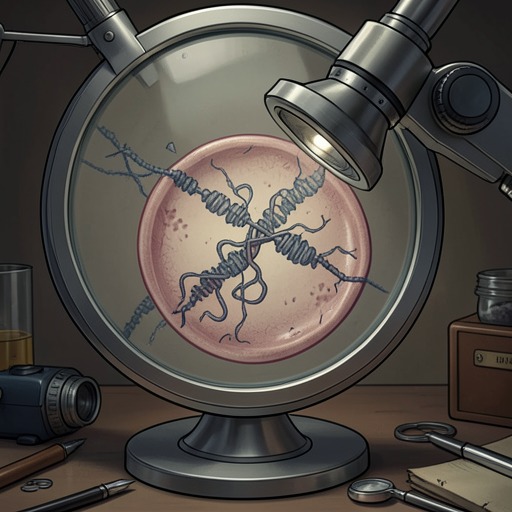
A separate line of evidence comes from research into chromosome abnormalities. A group at the University of Wisconsin headed by Klaus Patau studied congenital abnormalities that commonly included intellectual disability and appeared to result from duplication of only part of a chromosome. The proposed sequence is concrete: during the formation of a germ cell, a chromosome may break, and its pieces may not be redistributed properly. Such an error can interfere with the normal development of the embryo, connecting a microscopic irregularity in inherited material to multiple defects at birth.
The book distinguishes these partial abnormalities from the presence of an entire extra body chromosome. According to the knowledge it reports, an entire extra chromosome is usually lethal and prevents the embryo from surviving. An extra attached fragment, by contrast, can be seriously damaging without necessarily being fatal. The Wisconsin investigators considered that situation a possible explanation for a substantial share of cases that remained unexplained, in which a child was born with multiple defects, often including intellectual disability. These findings describe one route to congenital abnormalities; they do not establish that environmental chemicals caused the chromosome changes.
The field was still new. Scientists had concentrated more on identifying chromosome abnormalities associated with disease than on determining their full causes or implications. The chromosome research thus sharpens the picture of developmental disruption without closing the causal question raised elsewhere in the book. Alongside the experiments involving insufficient oxygen and the concern about chemical exposures, it presents birth defects as outcomes that may arise through different processes and that demand investigation beyond the mere act of counting them.